Evolving with AI: A Software Engineer’s Journey
Published:
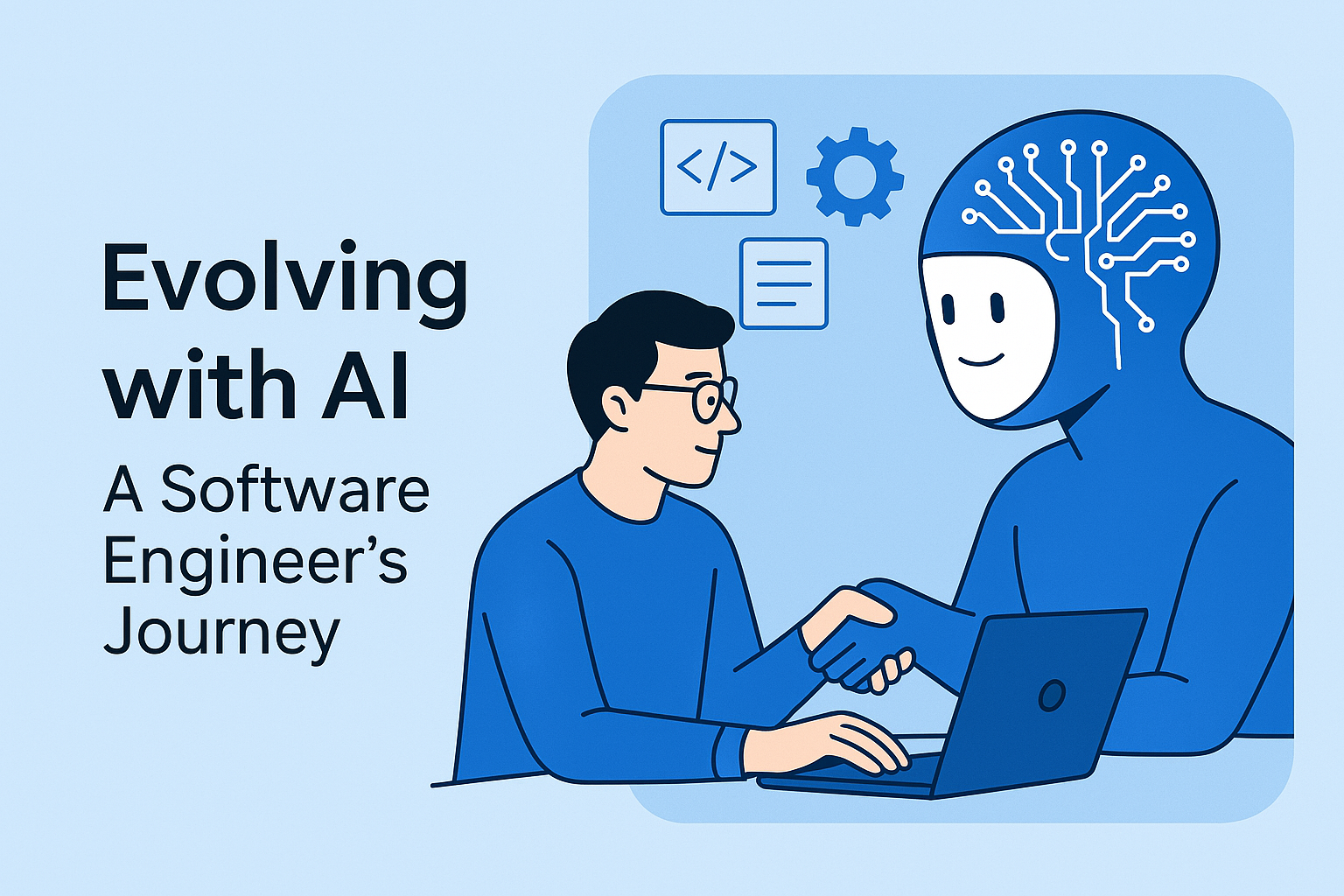
The field of software engineering is undergoing a profound transformation with the rapid advancement of Artificial Intelligence (AI). As AI becomes increasingly integrated into everyday applications—from recommendation systems and chatbots to code generation and intelligent infrastructure—the role of a software engineer is expanding beyond traditional programming. To remain effective, relevant, and innovative, today’s software engineers must evolve alongside these technologies.
🧠 From Code-Centric to AI-Aware
Historically, software engineers focused on algorithms, data structures, system design, and efficiency. While these remain foundational, the new era demands AI literacy. Engineers are now expected to understand how AI models work, how they’re trained, and how to integrate them responsibly into systems.
This doesn’t necessarily mean becoming an AI researcher—but it does mean knowing:
- How to use pretrained models (e.g., via Hugging Face, TensorFlow Hub)
- Basics of model inference, latency, and optimization
- Data engineering principles for AI pipelines
- Limitations and failure modes of models (e.g., bias, hallucination)
⚙️ Integrating AI into Software Workflows
AI is becoming a core part of software systems, not just a bolt-on. Engineers should know how to:
- Use APIs for AI models (like OpenAI, Google Vertex AI, etc.)
- Build inference pipelines with scalable infrastructure (e.g., FastAPI + TorchServe)
- Manage model lifecycle: downloading, versioning, and monitoring
- Deploy AI in edge, cloud, or hybrid environments
This represents a shift from writing functions to orchestrating intelligent components.
📦 Evolving Toolkits and Practices
The software toolchain is also evolving to include:
- Prompt Engineering: How you ask the model matters.
- Vector Databases: For similarity search, retrieval-augmented generation (RAG), and memory.
- Data-Centric Development: A focus on high-quality, well-labeled, and representative data over just models.
- Explainability & Monitoring: Interpreting model outputs and maintaining trust in production.
Version control for models (DVC, MLflow), containerization (Docker, KServe), and even test-driven AI development are becoming important practices.
🧑💼 Changing Roles and Mindsets
AI is not just changing how we build software—it’s changing what we build and how we think about the role of software itself. Software engineers are evolving into:
- AI-Enhanced Developers: Using tools like GitHub Copilot or TabNine to speed up coding.
- AI System Integrators: Designing workflows that include humans + models + automation.
- Ethical Technologists: Responsible for ensuring transparency, fairness, and security in AI-powered systems.
- Cross-Disciplinary Collaborators: Working closely with data scientists, domain experts, and UX designers.
🎯 Staying Relevant in the AI Era
To thrive in this new landscape, software engineers should focus on:
- Continuous Learning – Stay updated with AI trends, tools, and frameworks.
- Experimentation – Build small AI-powered tools to gain hands-on experience.
- Collaboration – Engage in cross-functional teams with ML engineers, researchers, and product leads.
- Critical Thinking – Evaluate when AI is the right solution—and when it’s not.
🌱 Conclusion
AI is not replacing software engineers—it’s redefining what it means to be one. The most impactful engineers of tomorrow will be those who embrace AI not just as a tool, but as a collaborative partner in building smarter, more adaptive systems. The journey ahead is not just about writing code—it’s about shaping the future of intelligent software.